
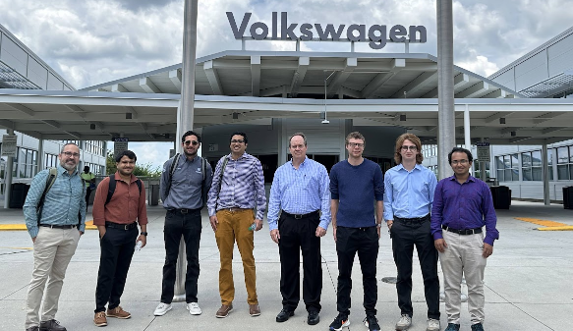
From Left to Right: Hector Santos (UTK), Azizul Zahid (UTK), Raul Trevino (VW Chattanooga), Sai Swaminathan (UTK), Dan Scott (UTK), Avery Stubbings (UTK), Stanley Barnes (UTK), Imran Fahad (UTK)
Fostered by collaborations between AI TechX, Volkswagen Group of America (VWGoA), and the Tickle College of Engineering at the University of Tennessee, Knoxville (UTK), the Volkswagen Edge AI Project is developing smarter ways for auto manufacturers to evaluate vehicles before they hit the market.
The Volkswagen Edge AI Project was one of nine projects led by UTK faculty to receive the first round of seed funding from AI TechX in 2025. Initiated in November 2025, the project brought together Steffan Nunn, an IT project integration specialist at Volkswagen; Raúl Treviño, a cloud architecture specialist working with Volkswagen Chattanooga Operations; and the project’s principal investigator, Sai Swaminathan, an assistant professor of electrical engineering and computer science at UTK. Their goal? Determine how AI-enabled quality inspection could become faster, more affordable, and easier to scale.
Costs, Cameras, and Computing Power
Current AI-enabled camera solutions on the market can cost thousands per device, not including other infrastructure needs, or hefty subscription fees, while cloud-based approaches can add recurring costs and introduce delays as images move between the production line and remote computing resources. Scale, real-time response, cost, and model customizations are all drivers in AI solutions. In highly competitive markets like the auto industry, Volkswagen is constantly working to develop more efficient, cost-effective ways to ensure vehicles pass all safety and quality inspections.
“Everyone’s going after computer vision for quality inspection; it’s becoming a crucial part of the process. Over the last year, it’s just exploded as a priority for all industrial manufacturers,” said Nunn.
Executing a Vision
The team worked with data from Volkswagen’s North American manufacturing facility in Chattanooga to develop AI systems and methods for real-time inspection. The factory’s existing environment included 32 deployed AI-powered cameras. The research focused on moving AI processing to the “edge,” meaning a compact computer analyzes camera images close to the production line rather than relying primarily on a central server or the cloud.
“If you don’t understand the production line, it’s costing companies a lot of money,” said Treviño. “Partnering with AI TechX and the university has helped us bring fresh ideas to our work and new technological discoveries that are helping to improve our processes.”
In an initial cockpit-inspection test, UTK graduate student Avery Stubbings, working closely with the broader project team, led the end-to-end technical development of an edge-AI system that processes camera images locally rather than sending them to the cloud. Running on a compact NVIDIA Jetson Nano computer, the system distinguished among nine assembly conditions with 92% initial accuracy. Because the approach is designed for potential integration with Volkswagen’s existing equipment, the team estimates that it could reduce hardware costs by as much as 98% compared with current commercial solutions. The team achieves this by using neural architecture search—an automated method for identifying suitable AI model designs—to balance accuracy, speed, and computational efficiency on low-cost hardware.
Partnership = Progress
By providing seed funding, access to talent, AI hardware solutions, and trusted university collaboration, AI TechX is de-risking AI adoption for major corporations like Volkswagen. Thanks to work like this, Tennessee is moving AI implementation from theory into on-site practice in everyday workplaces that continue to improve efficiency and safety.
“The Volkswagen Edge AI Project shows the power of collaborative innovation. By bringing together industry expertise, university research, and AI TechX resources, this team developed a practical solution that moves advanced AI from the lab to the factory floor,” said Caleb Knight, Director of AI TechX.
“Moving a promising AI system like this from a research and development phase to real-world production settings is not always straightforward,” said Swaminathan. “Industry collaboration gives us access to the practical constraints that determine whether a technology can actually succeed—from cost and computing resources to usability and deployment at scale..”
Heading into Year 2, the team plans to deepen its work in Chattanooga and determine how to implement the technology as a scalable production-floor system with an easy-to-use interface for automated training, testing, and device deployment for a variety of use cases.
“The first phase involved a lot of investigation and gathering insights for cost-effective ways of deploying these models,” said Treviño. “The next step is using that expertise to apply that into framework in the real world.”
Interested in joining the AI TechX consortium?
Learn more about our current consortium members and partnership opportunities.