Tennessee Students—do you have an idea that could make your community better? Bring it to life with AI.
The AI Tennessee Challenge invites K-12 students across Tennessee to identify a real problem in their community and explore how artificial intelligence can help solve it. Whether you’re proposing a bold new idea or building a working prototype, this is your chance to think like an innovator, practice responsible AI skills that matter for your future, and be recognized alongside students from every corner of Tennessee.
Building on the success of the national Presidential SI Challenge, this statewide challenge launches this fall, with regional winners from East, Middle, and West Tennessee earning a spot at the December Student Showcase and a head start on the national Presidential SI Challenge.
Quick Facts
- Open to Tennessee students in grades K-12
- Individual and team participation welcome
- Adult sponsor required
- Three grade bands: Elementary, Middle, High School
- Nine Regional Winner teams statewide
- Student Showcase during Computer Science Education Week (December 7-12)
Collaborating Organizations





About the Challenge
What is the AI Tennessee Challenge?
Artificial intelligence is transforming the way we learn, work, and solve problems. The AI Tennessee Challenge invites students to explore how AI can be used responsibly and creatively to address issues that matter to their communities.
Participants may choose to examine a local problem, investigate a community need, improve an existing process, or design a new AI-powered solution. Projects may focus on topics such as education, healthcare, agriculture, accessibility, the environment, workforce development, public safety, or other challenges important to Tennessee communities.
Students will gain experience in research, problem-solving, communication, ethical decision-making, and responsible AI use while developing projects that demonstrate innovation and impact.
Eligibility
Who Can Participate?
The AI Tennessee Challenge is open to K-12 students attending school or being homeschooled in Tennessee.
Grade Bands
- Elementary School (K-5)
- Middle School (6-8)
- High School (9-12)
Elementary Category
- Classroom teams, small groups, and youth organizations are eligible. Teams of 1-5 students.
- Elementary students should use AI tools under adult supervision.
- A sponsoring adult submits on behalf of participating students.
Middle School Category
- Grades 6-8
- Individuals or teams of 1-4 students
- One sponsoring adult required
High School Category
- Grades 9-12
- Individuals or teams of 1-4 students
- One sponsoring adult required
Sponsoring Adult
This is a student-focused challenge and does not include a separate educator competition category at this time. Teachers (private, public, or homeschool), librarians, instructional coaches, and community leaders may serve as sponsoring adults. Sponsoring adults must be at least 21 years old and do not need prior AI experience to participate. For those new to AI, please see the Resources for ideas.
Student Work Requirement
Students must complete the substantive intellectual and creative work themselves. Adult sponsors may guide and support the process, but project ideas, decisions, and products should reflect student work. 100% of the project’s content must be original content and created specifically for the Challenge. Note that you are allowed to use the same idea for the AI TN Challenge and the Presidential SI Challenge this year.
Homeschool Verification
A homeschool educator is eligible to serve as an adult sponsor if they provide one of the following forms of verification:
- A current school year dated copy of a letter of intent to homeschool one or more students in a Tennessee county in which their students reside;
- A copy of the current school year membership ID to a homeschool association; or
- A dated proof of purchase of curriculum for the current academic school year.
How the Challenge Works
Step 1: Identify a Problem
Choose a real-world challenge affecting your school, community, industry, or region.
Step 2: Research and Explore
Learn about the problem, gather evidence, and understand the people affected.
Step 3: Develop an AI Solution
Develop a solution, gather evidence, create or prototype, test ideas, seek feedback, and revise.
Step 4: Create Your Submission
Develop your project materials and explain your thinking, research process, and solution.
Step 5: Share Your Work
Submit your project for judging and compete for recognition at the online statewide showcase.
Timeline
Interested in participating? Sign up now for updates to receive challenge resources, webinar invitations, and project submission information.
| Date | Milestone |
|---|---|
| October 19 | Challenge is LIVE! |
| October 23 | Live Kickoff & Information Session (9 am- 9:45 am ET) https://tennessee.zoom.us/j/84462258622 |
| Oct 21 - Nov 23 | Problem Exploration, Team Formation, and Office Hours – register to sign up for reminders as well as submission and office hour links |
| November 24 @ 11:59 pm ET | Submissions Due |
| Nov 25 - Dec 7 | Judging Period |
| December 11 | Winners Announced & Virtual Celebration (CS ED Week) |
| December 14-18 | Refine Projects for Presidential SI Challenge – virtual office hours to support winning teams |
| December 18 & 23 | National PSIC Deadlines – register by Dec 18 and Submit by Dec 23 |
| Date | Event | Focus |
|---|---|---|
| October 1 | Kickoff & Information Session | Introduce challenge, eligibility, submission expectations, responsible AI, judging, and connection to the Presidential SI Challenge |
| October 1 - 15 | Problem Exploration & Team Development | Identify a problem, investigate community needs, form teams, begin researching |
| October 15 | Virtual Office Hours #1: From Problem to AI Idea | Optional support session for brainstorming, community relevance, AI applications, feasibility, and questions |
| October 16 - 30 | Design & Development | Develop solution, gather evidence, create/prototype, test ideas, seek feedback, and revise |
| October 26 | Virtual Office Hours #2: Preparing Your Submission | Optional support session focused on testing, responsible AI, narrative, visual, video, and submission questions |
| November 5 at 11:59 PM ET | Submissions Due | Narrative + visual + video submitted as one project package |
| November 7 - 16 | Regional Judging | Projects evaluated by region and grade band |
| November 18 - 23 | Final Review & Notification | Nine regional winners selected and notified before Thanksgiving |
| December 7 - 12 | Student Showcase — CS Education Week | Nine regional winning teams invited to showcase their projects |
| December | Optional Presidential SI Challenge development | Teams may continue refining their work toward a Presidential SI Challenge submission |
Submission Requirements
Every project submission includes:
✅ Project Narrative
✅ Project Visual (5-8 Slides)
✅ Project Video (3-5 Minutes)
Artifact 1: Project Narrative
Recommended length: 2 pages (12-point font)
Students should address:
- The Problem
What problem or opportunity did you identify? Why does it matter? - The People & Context
Who is affected by the problem? What did you learn about their experiences, needs, or perspectives? - The AI Solution
What are you proposing or creating? How does AI contribute to the solution? Why is AI appropriate for this problem? - Research & Evidence
What did you learn through research, data, interviews, observations, or other sources that informed your solution? - Development & Testing
What did you create, prototype, investigate, or test? What feedback did you receive? How did your thinking or solution change? - Responsible AI
What issues related to accuracy, bias, privacy, safety, accessibility, ethics, or limitations did you consider? How did you address them? - Learning & Next Steps
What did you learn? What would you change, investigate, test, or build next?
Students should also identify the AI tools/technologies used during the project, including tools used to help develop the submission itself. See Use of Generative AI section for more information.
AI Use Disclosure
Students must include:
Tools Used
List any AI systems used, and how AI was used.
Examples:
- brainstorming
- coding assistance
- image generation
- research support
- writing feedback
Human Contributions
Describe what decisions and work were performed by students.
Verification
Describe how AI-generated outputs were checked for accuracy.
Use of Generative AI: Direct use of generative AI tools/technologies is not required to participate in the AI Tennessee Challenge. Some of the strongest ideas start on paper, through discussion with peers, or by exploring how AI shows up in everyday life. In fact, this is exactly how the national championship team got started for the Presidential AI Challenge! Students can research, design, and complete their entire project, including the narrative, visual, and video, without using any generative AI tools or chatbots.
Adult sponsors may choose an approach that works best for their students, such as discussion or paper prototypes, and still fully compete for recognition. More details are in the Submission Requirements.
Artifact 2: Project Visual (Slides)
Submit a presentation consisting of 5-8 slides.
The slides should help someone quickly understand the project and include, as appropriate:
Problem → People → AI Solution → Process → Evidence → Responsible AI → Next Steps
Students may include:
- diagrams
- photographs
- screenshots
- data
- prototype images
- process sketches
- research findings
- testing results
- quotes/feedback
The slides will later serve as the basis for the team’s display at the December Student Showcase.
Artifact 3: Project Video
Submit a 4 minute (maximum) video that tells the story of your project. The video entry should tell a compelling story and include methods and insights not provided in the written entry to create a novel presentation.
The video is the team’s opportunity to tell the story of the project in their own voices. Students should help judges understand:
- What problem did you identify?
- Why does it matter?
- What did you learn about the problem?
- How does your solution use AI?
- What did you create, design, or propose?
- What did you test or learn through the process?
- How did your idea change?
- What responsible AI issues did you consider?
- Where would you take the project next?
- What was one thing the AI did well and one thing it did poorly? How did your team use human judgment to improve the result?
Students are encouraged to show their work rather than simply describe it. Videos might include prototypes, demonstrations, screenshots, slides, testing, or other evidence.
Professional video production is neither expected nor scored. Judges should focus on students’ ideas, thinking, evidence, and ability to communicate their work and not on editing, equipment, or production quality.
Use of Generative AI
Students are not required to use generative AI tools, AI chatbots, or AI image generators to participate in the AI Tennessee Challenge.
Some of the strongest ideas begin with community observation, discussion, research, paper prototypes, and creative problem-solving. Students may complete their entire project, including the narrative, slides, and video, without using generative AI tools.
Projects are judged on the quality of the problem, research, proposed solution, and responsible AI considerations, not on whether a generative AI tool was used.
Any AI tools used must be disclosed as part of the project submission.
Judging & Awards
How Projects are Evaluated
The narrative, visual, and video are not three separate competitions or scores. Together, they provide evidence of the project’s quality.
Judges will review the project package as a whole using a single rubric. Projects should be evaluated according to developmentally appropriate expectations for the team’s grade band. Technical sophistication alone should not determine project quality. There should be clear evidence that students drove the thinking, decision-making, and development of the project.
Scoring Rubric
| Criterion | Points | Judges Look For |
|---|---|---|
| Problem & Community Relevance | 20 | The project addresses an authentic problem or opportunity. Students clearly explain why it matters and demonstrate understanding of the people/community affected. |
| Purposeful Use of AI | 20 | AI plays a meaningful and appropriate role in the proposed solution. Students demonstrate understanding of what AI contributes and why it is useful for this problem. |
| Research & Evidence | 15 | Students investigate the problem using appropriate sources, data, observations, interviews, feedback, or other evidence. Research meaningfully informs the solution. |
| Design, Testing & Iteration | 20 | Students demonstrate a thoughtful development process. They create, prototype, test, gather feedback, revise, or otherwise provide evidence of learning through the process. |
| Responsible AI | 15 | Students thoughtfully consider relevant issues such as accuracy, bias, privacy, safety, accessibility, ethics, transparency, and limitations. |
| Communication & Creativity | 10 | The project demonstrates creativity and the narrative, visual, and video collectively communicate the students' problem, solution, process, and learning clearly. |
| TOTAL | 100 |
Regional Recognition
Submissions will be considered within three regions: East Tennessee, Middle Tennessee, and West Tennessee. One project from each grade band will be selected from each region, resulting in nine Regional Winner teams statewide. The nine selected teams will be recognized as AI Tennessee Challenge Regional Winners and invited to participate in the Student Showcase.
Awards
All participants who submit a compliant project to the AI Tennessee Challenge receive a digital Certificate of Participation. Additional prizes for winning teams will be announced at a later date.
Resources
Four Golden Rules for AI
Responsible AI Principles for the AI Tennessee Challenge
 Protect Privacy
Always protect personal information about yourself and others.
 Verify Information
Check facts, use evidence, and cite sources.
 Be Transparent
Clearly specify how AI was used to support your work.
 Use Human Judgement
People are responsible for evaluating results and making decisions.
Additional AI Learning Resources
- AI Tennessee Challenge info sheet
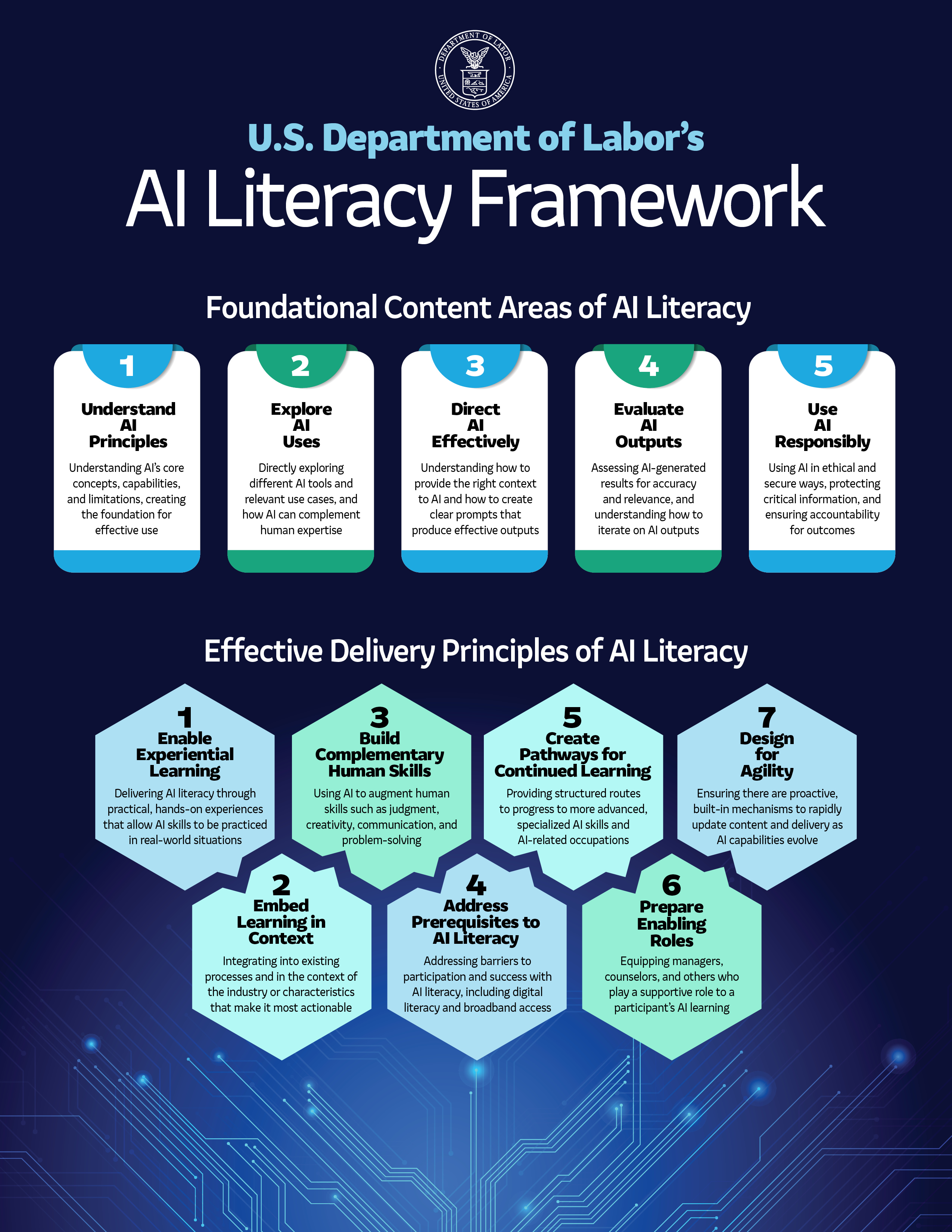
- U.S. Department of Labor AI Literacy Framework: A national framework providing guidance for building AI literacy across the workforce and education systems
- Make America AI Ready: A free, 1-week AI literacy course for every American — delivered entirely by text message.
- Presidential SI Challenge Resources
- Four Golden Rules of AI classroom poster
Frequently Asked Questions
Do I need coding experience to participate?
No. Students may develop ideas, concepts, prototypes, research-based proposals, or technical solutions. Successful projects focus on meaningful problem-solving and thoughtful use of AI.
Can I work on a team?
Yes. Students may participate individually or as a team.
What AI tools can I use?
Students may use AI tools to support their work but should clearly identify any AI technologies used during project development. Sponsoring adults are encouraged to help student teams identify age-appropriate tools. See AI Use Disclosure.
Do students need to use ChatGPT or other generative AI tools?
No. Students may complete their entire project without using generative AI tools. Use of generative AI is optional, not required. See AI Use Disclosure and sign up for additional submission details.
Do I need an adult sponsor?
Yes. Every submission requires an adult sponsor.
How are projects judged?
Projects are evaluated using the statewide rubric and judged according to developmentally appropriate expectations for each grade band.
Does participation in the AI Tennessee Challenge impact my chances in the Presidential SI Challenge?
Participation or placement in the AI Tennessee Challenge does not affect the Presidential SI Challenge. Students can participate in the national challenge independently, but the AI Tennessee Challenge provides Tennessee students with additional mentorship and feedback before the national deadline.
Participants should not assume that meeting AI Tennessee Challenge requirements automatically satisfies Presidential SI Challenge eligibility or submission rules.
For the most current and authoritative information — including official eligibility criteria, team size limits, registration and submission deadlines, project categories, and consent/permission forms — please visit the official Presidential SI Challenge page at orise.orau.gov/si-challenge
How does the AI Tennessee Challenge differ from the Presidential SI Challenge?
The AI Tennessee Challenge is open to all and designed to support and prepare Tennessee students for the Presidential SI Challenge, but our program requirements, timelines, and categories may differ from those of the official Presidential SI Challenge. Participants should not assume that meeting AI Tennessee Challenge requirements automatically satisfies Presidential SI Challenge eligibility or submission rules.
For the most current and authoritative information — including official eligibility criteria, team size limits, registration and submission deadlines, project categories, and consent/permission forms — please visit the official Presidential SI Challenge page at orise.orau.gov/si-challenge. Requirements for the national Challenge are subject to change at any time at the discretion of the U.S. Government.
Contact Us
Questions?
For questions or information regarding the AI Tennessee Challenge, please contact:
aitnchallenge@utk.edu
Collaborating Organizations