
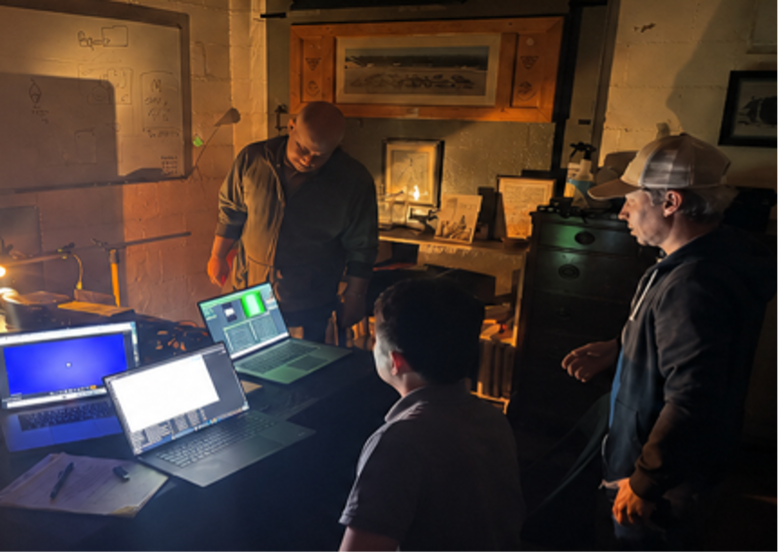
EnSenSys Sensor Engineer Ted Moore discusses recent ESS Protect AI analysis with Dr. Hao Gan and Dr. Safal Kshetri of UTIA at the EnSenSys facility near Alamo, Tennessee.
AI TechX member Enterprise Sensor Systems LLC (EnSenSys) and researchers at the University of Tennessee Institute of Agriculture (UTIA) are developing ESS Protect as a non-invasive disease detection system for cattle, bringing hyperspectral sensing to the point where animals are worked.
Supported by the AI TechX Seed Fund and led by UT Associate Professor Hao Gan, PhD, the project combines ESS Protect technology with UTIA expertise in artificial intelligence and machine learning. The objective is practical: identify disease-related spectral signatures in animal breath and use AI to distinguish them quickly enough to support animal health, biosecurity, and producer decisions.
Building the Evidence for Field Deployment
The team’s current model focuses on Bovine Viral Diarrhea (BVD), a contagious, economically damaging disease in cattle, utilizing four data buckets: clean air, healthy animals, BVD, and “all other diseases.” In research conducted in the Spring 2026, EnSenSys identified a BVD signature and UTIA independently validated the finding. The current project will determine whether that signature remains unique when cattle carry other pathogens under commercial conditions. A two-day breath capture trial at a commercial cattle operation is designed to answer just that. BVD must be separable from the “all other diseases” category before the team moves on to identify signatures for other specific pathogens.
“From an animal-health standpoint, this is the test that matters,” said James Buck, EnSenSys Chief Animal Health Officer. “Finding the BVD signature was important. Now we have to demonstrate ESS Protect can recognize it when other diseases are present and under everyday production conditions. When we can do that consistently, we have a path from research to chute-side use.”
Connecting the Right People
AI TechX’s value to EnSenSys extends beyond funding. By bringing together researchers, students, interns, and industry, the consortium is helping build the team needed to mature ESS Protect. AI TechX has connected EnSenSys with emerging talent, while Gan is also working with Assistant Professor Fuhar Dixit, PhD, of UT’s Department of Civil and Environmental Engineering and One Health initiative.
“Dr. Dixit’s work within UT’s One Health initiative fits naturally with what we are building,” said Steve Wakham, EnSenSys Chief Data Scientist. “ESS Protect connects animal health, human health, food security, and biosecurity. We need the right people together to turn research into a practical field capability.”
For the coming year, the focus is deliberately narrow: determine whether BVD can be reliably separated from all other diseases. Only then will EnSenSys and UTIA begin separating additional individual pathogens. That stepwise approach keeps the research tied directly to commercialization.
Applied AI for Animal Health
AI is not simply an add-on to ESS Protect; it turns hyperspectral breath captures into disease-detection decisions. For cattle producers, the end state is straightforward: disease detection at the point of handling, without swabs, reagents, or days of waiting for a laboratory result. If successful, ESS Protect could identify potentially infected animals sooner, strengthen herd biosecurity, reduce exposure, and lower the economic cost of disease.
Buck emphasized that the measure of success must remain grounded in cattle production.
“I keep coming back to one question: will this help the producer make a better decision at the chute?” Buck said. “The technology can be sophisticated, but the value must be practical. We need to separate a BVD animal from a healthy animal and from one carrying something else, fast enough to matter. AI TechX, Dr. Gan, and UTIA are helping close that gap between research and use. That is how ESS Protect improves herd health and the producer’s bottom line.”
“AI TechX exists to connect Tennessee’s industries with the researchers and students developing tomorrow’s technologies. The collaboration between EnSenSys and UTIA is a great example of that mission in action, bringing together AI, advanced sensing technology, and agricultural expertise to solve a real-world challenge,” said AI TechX Director Caleb Knight. “Agriculture remains a cornerstone of Tennessee’s economy, and we’re proud to support innovations that strengthen animal health, improve biosecurity, and create value for producers across our state.”
Interested in joining the AI TechX consortium?
Learn more about our partnership opportunities.